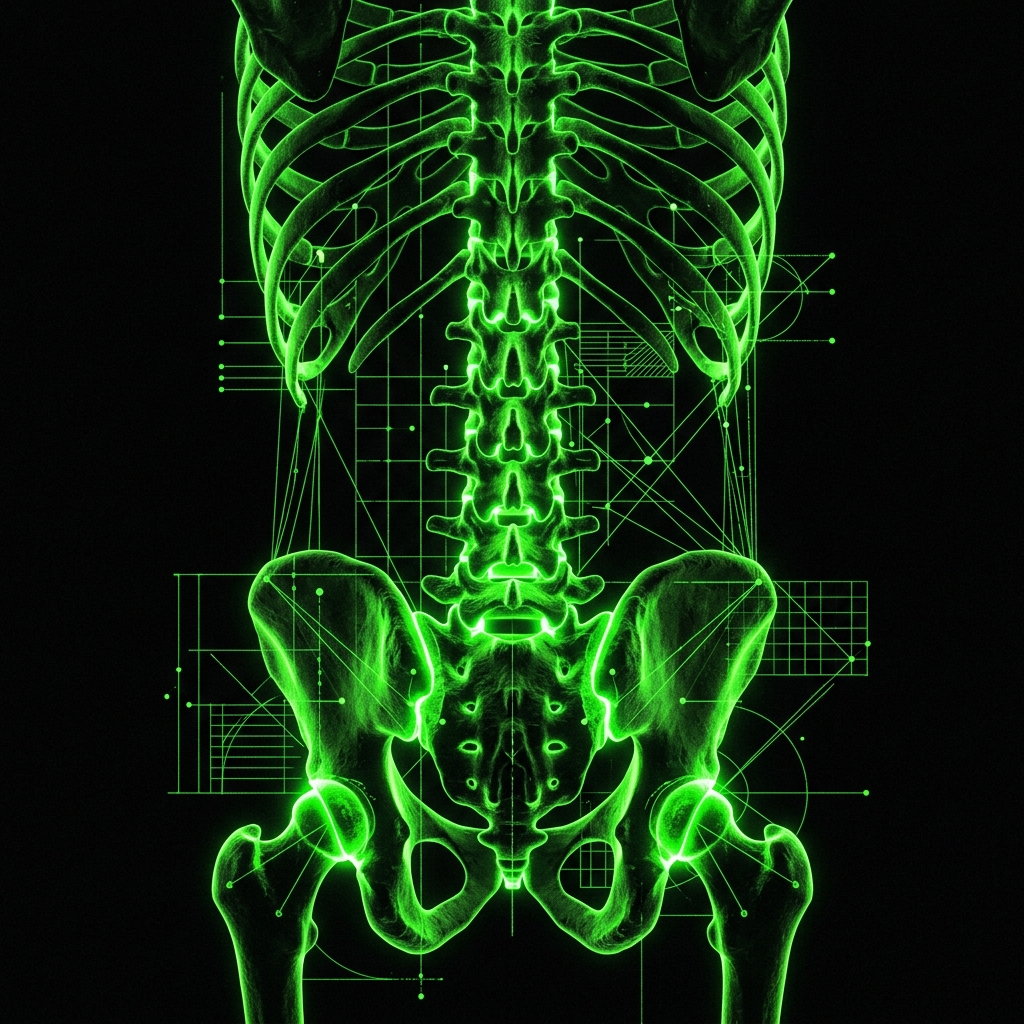
Biomechanical Insufficiency: Why Your Multijoint Movements Leave Fiber Strands Untouched
A core tenet of minimalist "functional" fitness is that a handful of multi-joint compound exercises (squats, deadlifts, presses) are all that is required to achieve complete muscular development. Proponents argue that if you squat heavy enough, your hamstrings will grow to their biological limit.
From an anatomical and biomechanical standpoint, this claim defies the fundamental laws of muscle architecture.
Specifically, it ignores the mechanical constraints of Active and Passive Insufficiency in bi-articular (two-joint) muscles.
The Bi-Articular Constraint
A bi-articular muscle is a muscle that crosses two distinct joint axes. Key examples include:
- The Hamstrings (except the short head of the biceps femoris): Crosses both the hip (extension) and knee (flexion).
- The Rectus Femoris (quadriceps): Crosses both the hip (flexion) and knee (extension).
- The Gastrocnemius (calves): Crosses both the knee (flexion) and ankle (plantarflexion).
- The Long Head of the Triceps: Crosses both the shoulder (extension/adduction) and elbow (extension).
- The Long Head of the Biceps: Crosses both the shoulder (flexion) and elbow (flexion).
Because these muscles possess finite mechanical length, their position across one joint drastically impacts their ability to generate contractile tension at the other.
The Physics of Active Insufficiency
Active Insufficiency occurs when a bi-articular muscle is placed into a shortened position across one joint, leaving it biochemically incapable of generating meaningful tension or shortening further across the second joint.
At a sarcomere level, the actin and myosin filaments overlap to such an extreme degree that cross-bridge binding sites are mechanically blocked. The muscle enters a state of structural slack.
Consider the Hamstrings during a Back Squat: As you descend into the hole of a squat, two things happen simultaneously:
- Your hips flex, which lengthens the hamstrings at the hip.
- Your knees flex, which shortens the hamstrings at the knee.
Because the muscle is lengthening at one end while shortening at the other, its net fiber length barely changes throughout the entire range of motion. The hamstrings act merely as dynamic stabilizers to protect the knee joint; they experience almost zero mechanical tension or eccentric micro-tears.
This is why clinical MRI studies show that back squats produce massive hypertrophy in the single-joint vastus lateralis and gluteus maximus, but zero measurable hypertrophy in the rectus femoris and hamstrings.
The Passive Insufficiency Parallel
Conversely, Passive Insufficiency occurs when a full stretch across one joint limits the range of motion at the adjacent joint (e.g., trying to touch your toes with completely locked knees).
The Structural Programming Fix
To achieve complete regional hypertrophy in bi-articular muscle groups, you must isolate their distinct joint functions:
- Hamstrings: Never rely on squats. Pair a hip-hinge movement where the knee remains fixed (Stiff-Leg Deadlift or RDL for the lengthened hip extension component) with a seated leg curl where the hip is flexed at 90° (maximizing mechanical tension on the hamstrings across the knee joint).
- Rectus Femoris: Squats and leg presses leave the rectus femoris untouched. You must perform dedicated Leg Extensions (where the hip is stationary and knee extension occurs under load) or Sissy Squats where the hip is actively extended while the knee flexes.
- Triceps Long Head: Pushdowns primarily recruit the medial and lateral heads. To place the long head into its peak force-generating length-tension relationship, perform Overhead Triceps Extensions or Incline Cable Extensions where the shoulder is flexed to 120°–180°.
Stop expecting compound movements to defy structural physics. Program for the mechanics of each specific joint.