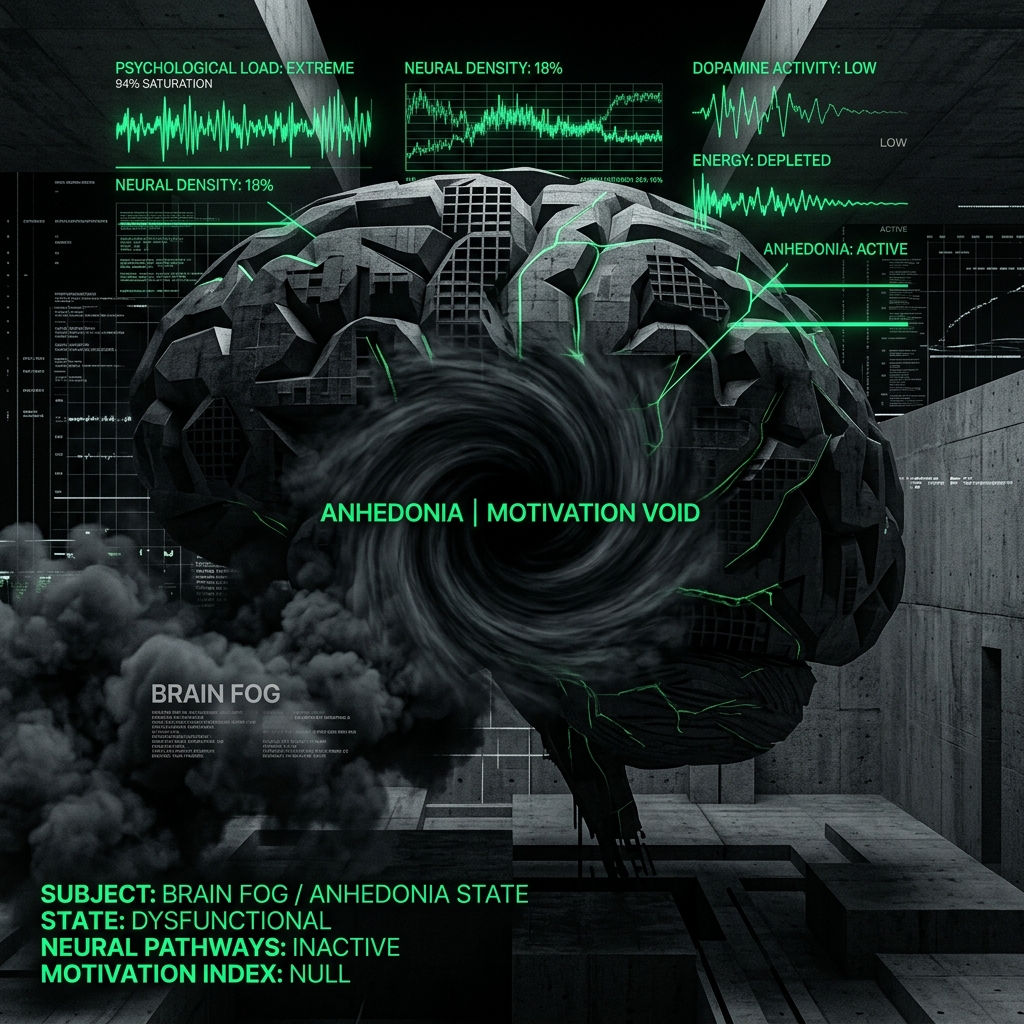
The Central Governor: How Your Motor Cortex Artificially Halts Reps Before Failure
You are on the sixth repetition of a heavy set of squats. The bar slows. Your quads burn with intense metabolic agony. Your chest heaves. As you struggle through the sticking point, your brain screams that your legs are completely exhausted. You re-rack the barbell, convincing yourself that you just reached "true muscular failure."
Scientifically, you did not even come close.
If someone placed a hydraulic press over your head and offered you ten million dollars to perform one more rep or die, you would have completed two more repetitions without hesitation.
Your muscle fibers were mechanically capable of generating force. What failed was your motor cortex's willingness to send the electrical signal.
You were stopped by your brain's unconscious protective governor: The Central Governor Model.
The Survival Algorithm of the Brain
First proposed by exercise physiologist Dr. Tim Noakes, the Central Governor Model posits that physical exhaustion is not a direct biochemical catastrophe occurring inside the peripheral muscle fibers (such as total ATP depletion or complete glycogen exhaustion).
Instead, physical exhaustion is an active, feed-forward, protective calculation executed by the subconscious brain to ensure immediate survival.
The human brain evolved under harsh ancestral conditions with one supreme directive: Do not allow the organism to damage itself beyond repair.
The brain constantly monitors an avalanche of physiological afferent signals:
- Blood oxygen saturation ($SpO_2$) and cerebral perfusion.
- Core body temperature and cardiac output.
- Intracellular pH, lactate accumulation, and glycogen depletion.
- Pain receptor signaling ($C$-fiber and $A\delta$-fiber activation).
When the brain calculates that the current rate of energy expenditure or mechanical strain poses an unacceptable threat to systemic homeostasis, it artificially decreases central motor drive.
The Efferent Motor Shutoff
The brain does not politely ask you to stop. It creates an overwhelmingly intense sensation of perceived effort, nausea, and localized pain to persuade your conscious mind to terminate the exercise.
Simultaneously, the motor cortex reduces the firing frequency (rate coding) of descending alpha motor neurons to the working muscles, and downregulates the recruitment of high-threshold Type IIx motor units.
The muscle feels "dead" not because its actin and myosin filaments broke, but because the electrical current feeding them was throttled down at the central breaker panel.
Rewiring the Governor
While the Central Governor exists for survival, in sedentary or moderately trained individuals, the governor is calibrated far too conservatively. It panics and pulls the alarm bell when the muscle is operating at only 65% of its true biological capacity.
To push the Central Governor's threshold closer to your true biological potential:
- Exposure to Controlled High-Involuntary Strain: Training with a strict spotter or inside safety pins to a verified RIR 0 (where the bar literally halts despite maximal voluntary effort) recalibrates the brain's internal threat assessment. The brain learns that extreme metabolic acidosis does not lead to cellular necrosis.
- Mental Decoupling from Discomfort: The sensation of "burn" (metabolic hydrogen ion accumulation) is merely data, not a directive to halt. Train your conscious prefrontal cortex to dispassionately observe localized muscular pain without reacting with emotional panic.
- Strategic Pre-Workout Focus: Auditory stimulation (high-intensity music), visualization, and deliberate adrenaline spikes temporarily elevate dopamine and noradrenaline in the brain, raising the Central Governor's pain tolerance threshold and delaying central motor shutoff.
Your muscles are vastly stronger than your brain allows you to believe. Train the nervous system to widen the governor's parameters.