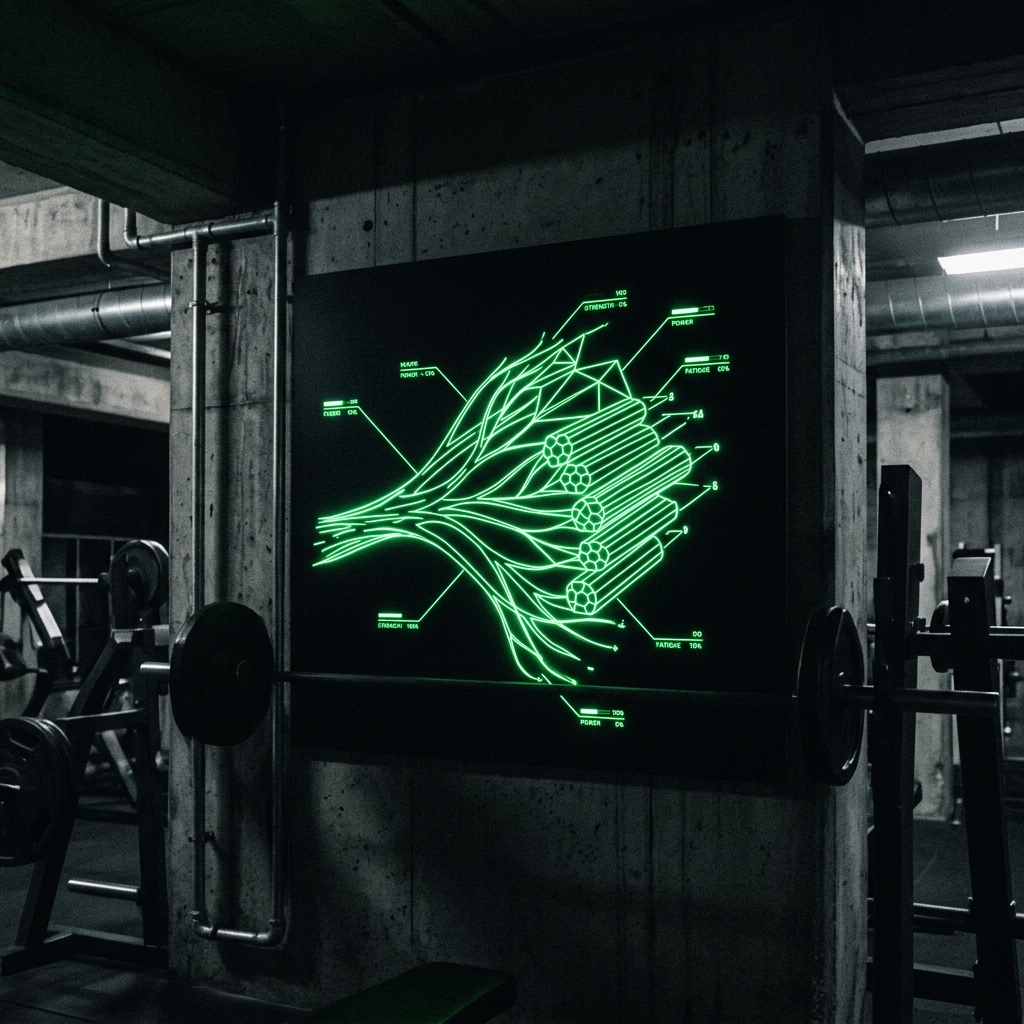
Dense Strength vs Fluid Volume: The Myofibrillar Divergence
In bodybuilding subcultures, a long-standing debate persists: is muscle growth simply muscle growth, or are there fundamentally different morphological types of hypertrophy?
Histological research proves that skeletal muscle expansion can occur through two distinct pathways: Myofibrillar Hypertrophy and Sarcoplasmic Hypertrophy. Understanding this mechanical distinction explains why a 75kg powerlifter can possess steel-cable tendon density and lift triple bodyweight, while an 85kg bodybuilder often displays soft, inflated musculature with fractionally lower relative force production.
The Architecture of the Sarcomere
A muscle fiber (myocyte) consists of two primary compartments:
- The Myofibrillar Apparatus: The contractile machinery itself—composed of actin, myosin, titin, and nebulin filaments organized in series and parallel into sarcomeres. This is the hardware that generates physical mechanical force.
- The Sarcoplasm: The semi-fluid interfibrillar matrix surrounding the myofibrils. It contains glycogen granules, water, mitochondria, sarcoplasmic reticulum, and intracellular enzymes.
The Divergent Stimuli
- Myofibrillar Hypertrophy (Sarcomerogenesis): Triggered by high mechanical tension (>75-85% 1RM) applied through complete or stretched ranges of motion. This activates focal adhesion kinase (FAK) and mechanically stimulates the transcription of new actin and myosin filaments, increasing the cross-sectional area of contractile protein. The muscle becomes structurally dense and capable of immense tension.
- Sarcoplasmic Hypertrophy: Triggered by high-volume, moderate-load training (12–20 reps) taken close to failure with short rest intervals. This creates intense cellular ischemia and metabolic byproduct accumulation ($H^+$, inorganic phosphate). To adapt, the cell swells its sarcoplasmic volume, expanding glycogen storage capacity and fluid retention without a proportional increase in contractile protein.
Physiques Built on Glycogen vs. Contractile Steel
Physiques built almost exclusively on sarcoplasmic pump work look incredible under optimal conditions—when hydrated, warm, and freshly pumped. But miss two days of carbohydrates or get dehydrated, and the muscles visibly deflate.
Physiques forged on heavy myofibrillar mechanical tension possess a dense, permanent hardness. The muscle bellies remain full and firm even in an unfed, unpumped, resting state because the bulk of the volume is made of structural protein chains, not transient water.
The Integrated Protocol
To build a physique that is both massive and structurally unbreakable, combine both modalities in a strict hierarchical order:
- Primary Compound Block (Myofibrillar): Dedicate the first 2 movements of your session to heavy compound loading (4–6 reps at 80–85% 1RM). Maximize mechanical tension, recruit high-threshold motor units, and stimulate sarcomere addition.
- Secondary Hypertrophy Block (Hybrid): 2 movements in the 8–10 rep range (70–75% 1RM) focusing on loaded stretch under control (3-second eccentric).
- Finishing Isolation Block (Sarcoplasmic): 1–2 sets of higher repetition work (12–15 reps) taken to mechanical failure to expand sarcoplasmic fluid, enhance glycogen storage, and trigger shear-stress endothelial adaptation.
Never build a home out of drywall without steel rebar. Build the contractile framework first.