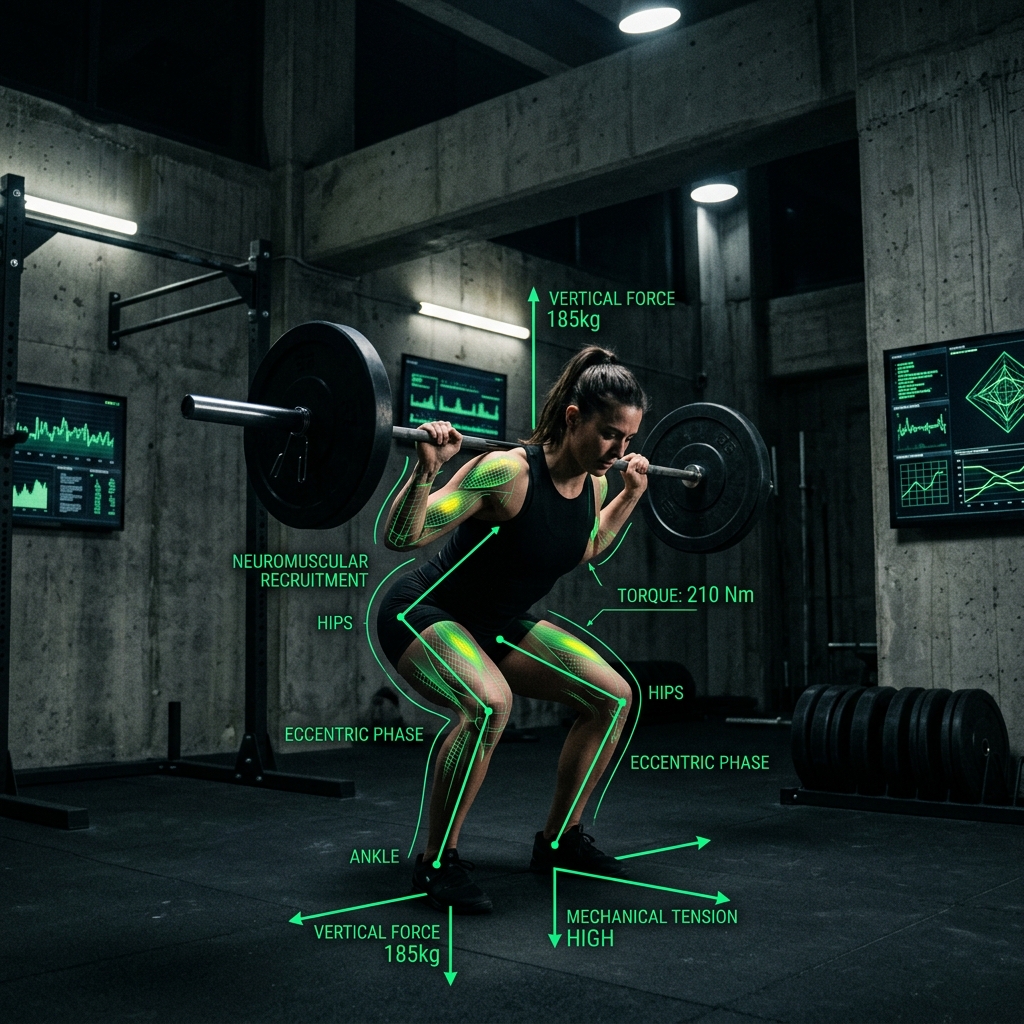
RFD Superiority: Why Fast Explosive Concentrics Recruit High-Threshold Motor Units
In commercial gyms, trainees are routinely instructed to perform repetitions with strict, slow tempos: "3 seconds up, 3 seconds down." The intention is noble—to increase "time under tension" and avoid using momentum to cheat the movement.
While a controlled eccentric (lowering) phase is biomechanically essential for muscular hypertrophy, intentionally moving slowly on the concentric (lifting) phase is a critical neuro-mechanical error.
Intentionally slowing your concentric speed actively prevents your nervous system from maximizing Rate of Force Development (RFD) and robs you of your highest-threshold motor units.
Henneman's Size Principle and the Dynamic Exception
Under static or slow muscular contractions, Henneman's Size Principle dictates that motor units are recruited in an orderly, hierarchical fashion:
- Small, low-threshold, fatigue-resistant Type I (slow-twitch) motor units are recruited first.
- As force demands rise or fatigue sets in, medium Type IIa motor units are brought online.
- Only at near-maximal force or near-failure are the largest, high-threshold Type IIx motor units recruited.
However, modern neuro-muscular research demonstrates a vital dynamic nuance to this law: Rate of Force Development can drastically lower the recruitment threshold of high-threshold motor units.
When you attempt to move a barbell with maximal explosive intent on the concentric phase, the central nervous system perceives an immediate, acute demand for high acceleration.
According to Newton's Second Law: $$F = m \times a$$ Force equals mass multiplied by acceleration.
If the load ($m$) is submaximal (e.g., 70% 1RM), you can generate massive peak force ($F$) simply by maximizing acceleration ($a$).
To achieve this instantaneous acceleration, the motor cortex bypasses the slow, progressive recruitment hierarchy and instantly fires high-threshold Type II motor units at the very initiation of the concentric contraction.
The Firing Frequency Factor (Rate Coding)
Moving with maximal concentric intent does not just recruit more motor units; it drastically enhances Rate Coding—the frequency at which action potentials are sent down the motor axon to the muscle fibers.
Higher firing frequencies cause individual muscle twitches to fuse into a smooth, sustained, maximal tetanic contraction, maximizing mechanical tension across the sarcomere from the very first inch of the movement.
If you intentionally lift that same 70% load slowly over 3 seconds, your acceleration is near-zero. Your nervous system only needs to recruit low-threshold Type I and IIa fibers to move the bar against gravity. You perform the entire set without ever stimulating the most growth-prone Type IIx fibers until the final grinding repetitions.
The Compensatory Acceleration Protocol
- Controlled Eccentric (2–3 Seconds): Lower the load under complete muscular control, maintaining tight joint alignment and feeling the target muscle stretch under tension. Do not drop the weight passively.
- Explosive Concentric Intent (Maximum Velocity): At the bottom transition point, reverse the movement and attempt to move the bar with 100% maximal explosive velocity, regardless of how heavy the weight is.
- Even if the bar moves slowly because the load is 85% 1RM, the neural intent to move it with maximum speed ensures maximal motor unit discharge frequency.
- Eliminate Voluntary Concentric Deceleration: On movements where you might decelerate at the top of the range of motion to protect joints (such as bench press lockouts), utilize accommodating resistance (bands or chains) to allow maximal acceleration all the way through the lockout.
Control the eccentric; explode through the concentric. Command maximum rate of force development.